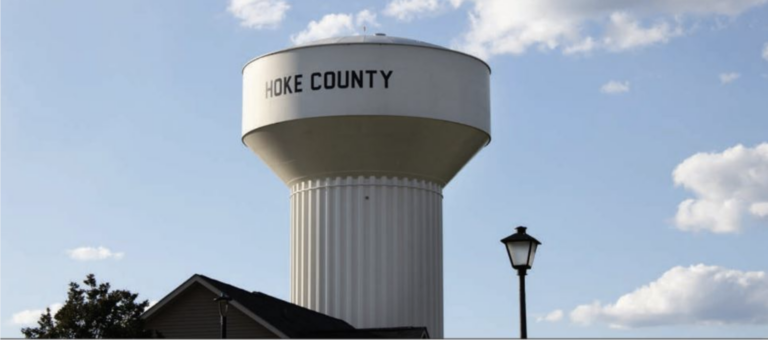

Hoke County residents are being asked to pay closer attention to the water they use as drought conditions and increased seasonal demand place additional pressure on the county’s water system, prompting Hoke County to implement Stage 1 Water Restrictions under its Water Shortage Response Plan. The restrictions took effect July 7, 2026, and apply to residential, commercial and governmental water customers, making water conservation a countywide responsibility that reaches households, businesses and public facilities throughout the Hoke County Regional Water System. Although Stage 1 primarily involves voluntary conservation rather than mandatory restrictions carrying penalties, the county’s decision represents an important reminder that maintaining a dependable water supply requires cooperation before conditions become severe enough to require stronger measures.
According to Hoke County’s official announcement, Stage 1 was activated because regional drought conditions had intensified while rainfall remained well below average and seasonal demand on the water system continued to increase. Those conditions create a situation in which everyday water consumption that might normally place manageable demands on the system can become more significant, particularly during periods when lawns, gardens, vehicles, swimming pools and other outdoor activities increase household water usage. Hoke County Utilities is monitoring system levels daily and coordinating with state water-resource officials, while customers are expected to be notified if conditions become serious enough to require an escalation to Stage 2 restrictions.
For Hoke County residents, Stage 1 Water Restrictions are primarily about reducing unnecessary consumption before a more serious shortage develops, which means conservation can begin with relatively simple changes around homes and businesses. The county is asking customers to limit outdoor irrigation to the minimum amount necessary while avoiding watering during the peak evaporation period between 10 a.m. and 6 p.m., when heat and sunlight can cause a greater percentage of irrigation water to evaporate before it benefits lawns and landscaping. Residents are also encouraged to reduce vehicle washing when possible and postpone nonessential activities such as pressure washing, swimming-pool refills and establishing new landscaping, while household leaks should be repaired promptly and water-efficient appliances and fixtures should be used whenever practical.
The county’s formal Water Shortage Response Plan provides additional perspective on what Stage 1 is designed to accomplish, because the plan calls for customers to voluntarily reduce normal water consumption by approximately five percent while improving overall efficiency. Recommended measures include limiting landscape irrigation, preventing runoff and the watering of paved surfaces, washing only full loads in dishwashers and washing machines, using appropriate nozzles on garden hoses and locating and repairing water leaks. A five-percent reduction may appear modest when considered within a single household, but the combined savings can become substantial when thousands of water customers make similar adjustments during the same period.
Conserving water also has implications that extend beyond keeping faucets running inside individual homes, because adequate system capacity supports essential community needs, including fire protection and other critical services. Hoke County specifically notes that small reductions by individual households can help preserve system capacity, support fire-protection capability and reduce the possibility that more restrictive conservation measures will become necessary. Water conservation during drought conditions should therefore be viewed as a community resource issue rather than simply a request for residents to reduce lawn watering, because maintaining sufficient supply and system capacity benefits homes, businesses, emergency services and the broader community.
The possibility of Stage 2 Water Restrictions is another reason residents should take the current voluntary measures seriously, because Hoke County’s Water Shortage Response Plan establishes a considerably stronger response if water-supply conditions deteriorate. Under Stage 2, conservation moves from voluntary reductions to mandatory requirements, with customers expected to reduce water use by approximately ten percent compared with their previous month’s consumption, while additional limitations are placed on outdoor water use. The plan also provides for progressively stronger stages if a water shortage becomes more severe, making early conservation one of the most practical ways customers can help reduce pressure on the system before mandatory measures become necessary.
The current water situation also arrives during a larger conversation about Hoke County growth and development, because water availability is not only an environmental concern but also an infrastructure and planning issue. During an April 2026 Board of Commissioners meeting, county leaders discussed water availability, allocation policies, infrastructure limitations and their effects on projects under consideration, ultimately approving an increase in water allocation capacity to approximately 80 percent while directing staff to compile a comprehensive list of pending developments and water-allocation requests. Those discussions demonstrate why water capacity is increasingly connected to decisions about where and how Hoke County grows, particularly when new neighborhoods and commercial developments create additional long-term demand on public infrastructure.
As Hoke County continues to develop, water planning will therefore involve more than responding to temporary periods of dry weather, because county leaders must also consider whether infrastructure and available resources can accommodate future residential and commercial demand. A growing population can strengthen the local economy and create opportunities for businesses and homeowners, but growth also requires sufficient roads, public safety services, schools, utilities and water capacity. The current Stage 1 restrictions provide residents with a timely example of how environmental conditions, infrastructure planning and community growth can intersect, creating challenges that require both short-term conservation and long-term planning.
North Carolina has also been dealing with significant drought conditions beyond Hoke County, making the local situation part of a broader statewide concern rather than an isolated problem. The North Carolina Department of Environmental Quality reported in late June that drought conditions continued across large portions of the state and encouraged residents to follow restrictions established by their local water systems. State officials also indicated that water systems in the most severely affected areas should follow their Water Shortage Response Plans and warned that some communities could move toward stronger conservation measures if conditions continued to deteriorate.
Residents can help immediately by examining the places where water is most easily wasted, because conservation does not necessarily require dramatic changes to everyday life. Waiting to run a dishwasher or washing machine until there is a full load, repairing a dripping faucet or leaking toilet, reducing unnecessary lawn irrigation, postponing pressure washing and being more selective about vehicle washing can collectively make a meaningful difference. Homeowners with irrigation systems can also examine schedules and sprinkler coverage to make certain water is reaching landscaping rather than driveways, sidewalks and streets, where runoff provides no benefit while adding unnecessary demand to the system.
Communication will remain particularly important as conditions change, which means residents should rely on official Hoke County information for updates rather than assuming Stage 1 conditions will remain unchanged throughout the season. The county maintains emergency and utility alerts through its website, while the Hoke County Utilities Department continues to monitor system conditions and can provide information concerning water-related issues. Residents with questions or water-related concerns can contact the Hoke County Utilities Department at 910-875-6704, and customers should watch for county announcements if changing drought or system conditions require modifications to the current conservation measures.
Hoke County’s Stage 1 Water Restrictions ultimately represent a request for residents, businesses and government users to act before a difficult situation becomes more serious, because protecting a community’s water supply is easier when conservation begins early rather than after supplies have reached critical levels. Every repaired leak, postponed pressure-washing project, shortened irrigation cycle and more efficient household routine contributes to a larger countywide effort, while responsible water use can help preserve system capacity for essential needs. As Hoke County continues navigating drought conditions, seasonal demand and long-term growth, residents have an opportunity to become part of the solution by treating water conservation not simply as a temporary inconvenience but as a shared responsibility for protecting one of the county’s most important resources.
About The Author